
Interview by Marina Oliveira Barbosa for the Digital Brazil Project
ODU
The arts cross temporalities. They are one of the most powerful forms of communication and resistance– a manifestation of freedom. Art technologies promote the gift of life and movement, they weave through bodies from head to toe, fostering a dreamlike rhythm of the tangible.
This online exhibition is part of an Afro-diasporic essay that dances with the sea and its waters, which are configured in various cartographies of forced displacement, as well as in the formation of (re)configured territories. Through the arts in dialogue with religions of African origin, cosmologies, worldviews and ginga embrace the chant of collectivity and its unsubmissive crossroads.
The translation of self and beliefs occupy the tangle of enchantments that sustain history and pull all shipwrecked bodies out of the drift. Each work exhibited here: theater, performance, sewing (embroidery and lace), paintings and installations; inevitably carry and elevate the scent of sweat, salt and sun, tears and black radicalism translated into presences that resonate with the past, but also pulsate with continuity—present time immersed in fluid imaginaries for new beginnings.
The artists and their works move the black Arkhé, speak from multiple visualities and communicate in poetry, tearing time apart, crossing over and giving texture and nuance to the ancestors and rhythm to the pemba's designs and the oduns of life, which nourish the giras. And in their eternal dichotomous mutability, the permanence of the sensitive is laid bare and revealed to us in formats that we can understand as enchanted images of the sacred.
pemba - a chalk used in Umbanda and Candomblé to paint dots in rituals and ceremonies.
odus - from the Yoruba language, meaning: paths.
gira - from Kimbundo (nijira) - paths. A gathering for the celebration of rituals where the manifestations of spiritual entities take place.
ginga - from Kimbundo (nginga) - swing or spin. More than just a movement, it is the “grammar of the body” in Brazilian capoeira, which symbolized struggle, resistance, and celebration.
Arkhé - beginning or origin
Muniz Sodré uses the term arkhé negra to explain how ancestrality in Afro-Brazilian religions functions as a beginning that grounds and maintains the continuity of Black cultures.
Featured Artists
Sheyla Ayo
AYO is a visual artist who explores the intersection of painting, performance, and feminine ancestry in her artistic practice. Her work moves between the organic and the spiritual, utilizing natural materials and experimental techniques to create visual narratives that engage with ancestral memories, rituals, and symbols.
With a career marked by exhibitions in major cultural venues in São Paulo and Rio de Janeiro, her work stands out for its fusion of tradition and contemporaneity. Through performance, she incorporates gestures and movements that draw upon ancestral knowledge, transforming her body into an extension of her paintings. Her artistic process seeks not only individual expression but also a reconnection with feminine lineages and the reframing of Black identity in the field of art.
Currently, AYO continues to expand her artistic explorations, creating works that evoke spirituality, nature, and the Ancestors.
.jpeg)
Myra Gomes
.jpeg)
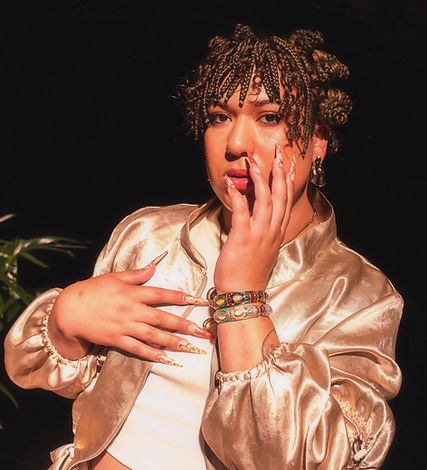
Myra Gomes, 26, born and raised in São Paulo, is a trans woman multi-modal artist who has been acting, directing, writing, and producing since 2022, the year she began her professional career in theater and film.
Playwright of the show “Dentro de Um Olhar,” Myra is also the director, screenwriter, and actress of the short film “Ebó de Xùxú,” a work awarded the Unicórnio de Ouro - Troféu Afronte at the 5th edition of Transforma Fest (2023). She conceived and adapted the research for “Ebó de Xùxú” for the stage as a performance piece, in which she is also part of the cast.
In Brazilian cinema, notable appearances include the docufiction short “A Dita Filha de Claudia Wonder” (2024), directed by Wallie Ruy, winner of the Silver Rabbit at Mix Brasil and the Golden Unicorn at the 6th Transforma Fest. In addition, she starred in the short film “Entre Raízes” (2023), directed by Alexandre Dkriwat, for which she was nominated for Best Actress at the Pinhais Film Festival and participated in the opening of the São Paulo Film Festival.
With a degree in theater technology from Senac Lapa Scipião and currently a student at the School of Dramatic Arts at USP, Myra has been building her legacy on the stage, leaving her mark, signature, and aesthetic.
Rafael Segatto
Rafael Segatto Barboza da Silva was born in 1992 in Espírito Santo, Brazil. He is a multidisciplinary artist and a maritime worker whose research and artistic practice move between continental and maritime domains.
His work is deeply rooted in aquatic ecosystems, with sea swimming, encounters with fishers, time spent in shipyards, and journeys along coastal regions serving as central elements of his methodology. Within these territories, he develops relationships of interaction, collection, and enchantment with materials, through which he creates a form of non-formal maritime archaeology expressed in paintings, sculptures, public artworks, and installations.
He held the solo exhibitions Linha-Mar (2024) at the Fisherman's Museum, Paciência de Pescador (2021) at the Espírito Santo Museum of Black Culture, and Caminhos Possíveis (2018) at the Homero Massena Gallery.
He has also participated in several group exhibitions, including Sete Caminhos: do MAES ao Quintal Bantu (2022) at the Espírito Santo Museum of Art, Gira (2019) at the Espírito Santo Museum of Black Culture, and Experiências Ímpares(2019) at the Virgínia Tamanini Gallery, all held in Vitória, Espírito Santo, Brazil.
Segatto was part of the collective of artists who developed Quintal Bantu (2019) alongside Master Renato Santos in Morro da Fonte Grande. The space was created to foster aesthetic, artistic, culinary, and musical experiences connected to Bantu culture in Espírito Santo. There, he created Monumento a Kitembo (2021), the first public artwork installed outside the central areas of Vitória.

%20.jpeg)
About the Curator

Marina Oliveira Barbosa is a social scientist, curator, and researcher whose work focuses on the intersections of anthropology, art, and culture. She holds a Ph.D. in Social Anthropology from Universidade de São Paulo (USP) and a Master’s degree in Art History from Universidade Federal de São Paulo (UNIFESP). She develops projects that move across different artistic languages, bringing together literature, visual arts, music, and research. As curator of the exhibition Odu, she deepens investigations into memory, territory, creativity, and cultural practices. Her trajectory is marked by the appreciation of Afro-diasporic Brazilian ancestries and by the creation of dialogues between artistic production, critical thought, and cultural preservation. Through curatorial practice, research, and writing, she contributes to expanding debates on heritage, identity, and the reinvention of narratives within the field of contemporary art.


